Budget FY 2026-27: Digital Infrastructure Can Drive Bangladesh's Next Wave of Investment
As Bangladesh prepares its national budget for FY 2026-27, policymakers face a familiar yet urgent challenge: how to restore investment momentum amid global uncertainty, constrained borrowing conditions, and cautious private sector spending. The question is no longer limited to sustaining economic growth. It is about positioning Bangladesh to attract the next wave of foreign direct investment (FDI) that can strengthen long-term productivity, innovation, and competitiveness.
One opportunity that deserves far greater attention in this conversation is digital infrastructure.
In today's economy, telecom towers, fiber networks, energy systems, and data platforms are no longer merely components of the telecommunications sector. They have become foundational infrastructure for the digital economy, much like highways, ports, and power grids were in previous phases of development. If Bangladesh wants to attract the next generation of global investment, strengthening digital infrastructure must become a national priority.
"If Bangladesh wants to attract the next wave of foreign direct investment, strengthening digital infrastructure must become a national priority."
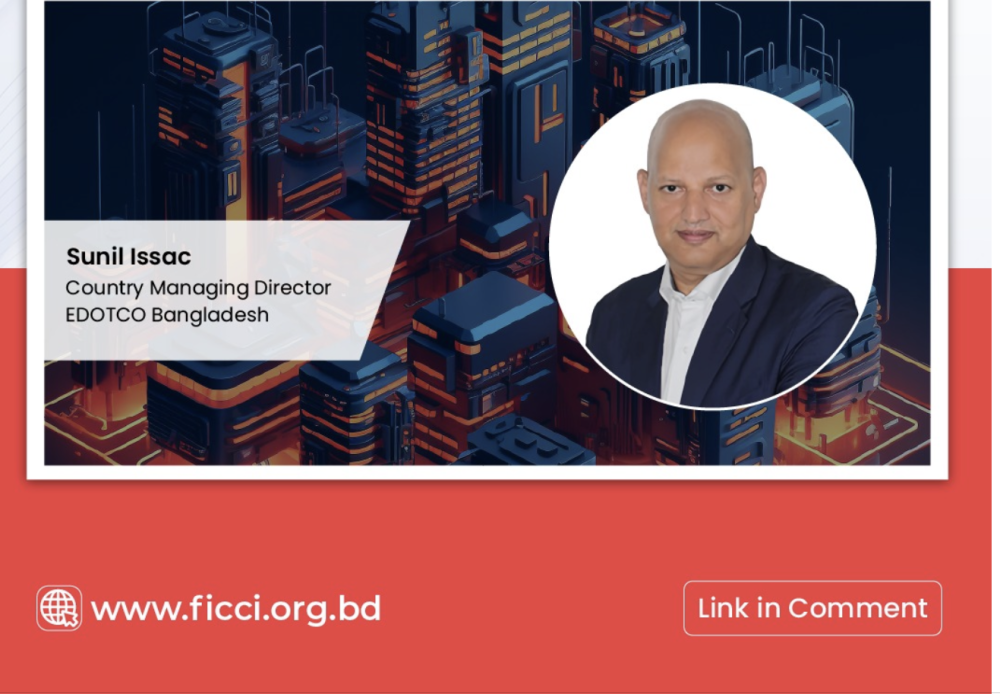
— Sunil Issac
Global capital is increasingly flowing into digital infrastructure platforms. Telecom towers, data centers, and connectivity networks are now viewed as long-term infrastructure assets capable of generating stable returns. Technology giants such as Google, Microsoft, Amazon, and Meta are investing billions of dollars worldwide in subsea cables, cloud infrastructure, and distributed computing platforms to support artificial intelligence and digital services.
Southeast Asia has emerged as a major destination for this investment. Malaysia's JENDELA digital infrastructure program has combined connectivity expansion with targeted investment incentives to attract hyperscale cloud and data center operators. Vietnam has integrated digital infrastructure development into its broader industrial strategy, enabling the country to attract technology manufacturers and global digital service providers. These countries understand that digital infrastructure is not simply a telecom sector issue—it is a strategic economic asset capable of anchoring future investment.
Bangladesh already possesses a strong foundation to participate in this transformation. With nearly 187 million mobile subscriptions and more than 129 million internet users, the country represents one of South Asia's largest digital consumer markets. Mobile connectivity now extends to almost every district and upazila.
Supporting this network is a nationwide infrastructure base of approximately 45,000 telecom towers. Shared infrastructure companies such as EDOTCO Bangladesh manage nearly 17,000 of these towers, allowing multiple mobile operators to use common infrastructure and expand coverage efficiently. This shared model has played a vital role in scaling connectivity throughout the country.
However, despite these strong fundamentals, the investment environment for digital infrastructure continues to face structural barriers.
The first challenge lies in the sector's fiscal framework. The telecommunications industry operates under one of the highest tax burdens in the region. Industry estimates suggest that more than half of sector revenue is absorbed through taxes, VAT, spectrum fees, and regulatory charges.
Digital infrastructure businesses require substantial upfront investment and often involve long payback periods. Such investments depend on a predictable and balanced fiscal environment. When the effective fiscal burden becomes excessive, it increases the cost of capital and diminishes the sector's attractiveness to both domestic and international investors.
At a time when borrowing conditions remain tight and private sector balance sheets are under pressure, fiscal reforms could play a critical role in stimulating investment.
The current taxation structure also creates avoidable inefficiencies. For example, the industry faces a 15 percent VAT deduction at source on tower revenue-sharing payments, despite VAT already being paid elsewhere within the value chain. This effectively results in double taxation.
At the same time, companies investing in telecom towers are unable to fully claim VAT credits on essential infrastructure inputs such as site rentals, tower components, and related equipment. Import duties on telecom towers and lithium-ion batteries—critical for ensuring network continuity during power disruptions—further increase capital costs.
These issues affect more than profitability. They directly influence whether new infrastructure investments happen at all.
Foreign investment frameworks are equally important. Infrastructure investors typically deploy capital over decades and seek predictable regulatory environments alongside flexible ownership structures.
Policy discussions around limiting foreign ownership in digital infrastructure companies to 65 percent risk sending the wrong message at a time when Bangladesh should actively compete for global infrastructure capital. International infrastructure funds generally prefer majority ownership structures to ensure governance stability and operational control. Restricting this flexibility could narrow the pool of potential investors and divert capital toward more open and competitive markets.
The national budget therefore presents an opportunity to reposition digital infrastructure as a strategic investment platform.
Several practical policy measures could strengthen Bangladesh's competitiveness:
-
Eliminate VAT on tower revenue-sharing payments to remove double taxation.
-
Allow full VAT credits on essential tower infrastructure inputs, including site leases, tower materials, and equipment.
-
Rationalize import duties on telecom towers and lithium-ion batteries to lower capital costs and accelerate network expansion.
-
Maintain an open foreign investment framework without restrictive ownership caps to signal Bangladesh's commitment to welcoming long-term infrastructure capital.
These reforms should not be viewed as sector-specific concessions. Rather, they are strategic fiscal instruments designed to stimulate investment during a period of constrained credit and cautious private sector spending.
Digital infrastructure supports the entire digital economy—from fintech and e-commerce to emerging technologies such as artificial intelligence and edge computing. Strengthening this infrastructure backbone can create the conditions necessary for broader digital investment, innovation, and job creation.
Bangladesh has already demonstrated its ability to build connectivity at scale. The next step is to transform that connectivity into a platform capable of attracting global digital infrastructure investment.
Capital is moving rapidly across Asia in search of stable infrastructure opportunities. Countries that align fiscal policy, investment frameworks, and regulatory clarity with this trend will capture that capital and accelerate their digital transformation.
As policymakers finalize the national budget for FY 2026-27, the choice is clear: Will Bangladesh compete aggressively for global digital infrastructure investment, or will it allow others in the region to seize the opportunity?
"However, high taxation, double VAT structures, and import duties on critical equipment continue to increase capital costs and limit large-scale infrastructure investment."
— Sunil Issac