A port doesn't become modern just because it's new, busy or making profits.
Vietnam's Cai Mep proves the point. In the 1990s it was, quite literally, swamp. Today, it ranks 7th globally and 5th in Asia for port efficiency. It rivals Singapore and fuels Ho Chi Minh City's rise as a coastal powerhouse. That took two decades.
The first shift was policy. Vietnam's early constraints will sound familiar: thin capital, fragmented assets, weak connectivity. In 2006, it liberalised-inviting foreign operators and capital. The state focused on channels and breakwaters; global players built and ran the terminals. Cai Mep became a joint-venture web of Vietnamese, Japanese, Singaporean and European partners.
But concrete wasn't enough. Limited shipping loops kept utilisation low. Vietnam responded by chasing direct connectivity. Today, Cai Mep runs 35 weekly international services, including direct routes to the US and Europe.
CMIT, operated by APM Terminals, is one of Southeast Asia's few terminals built for megavessels-with record productivity of 162 crane moves/hour.
The lesson is simple: it takes the whole tribe. Government, global operators, shipping lines, customs and the industrial ecosystem must move together to keep cargo flowing
Matarbari Deep Seaport has the right ingredients. Like Cai Mep, it's a deep-water play backed by Japanese ODA, built to anchor an industrial ecosystem. With an 18.5m natural draft, it can berth megavessels, handle both bulk and containers, and reduce shipping costs by up to 30%—if the logistics spine holds.
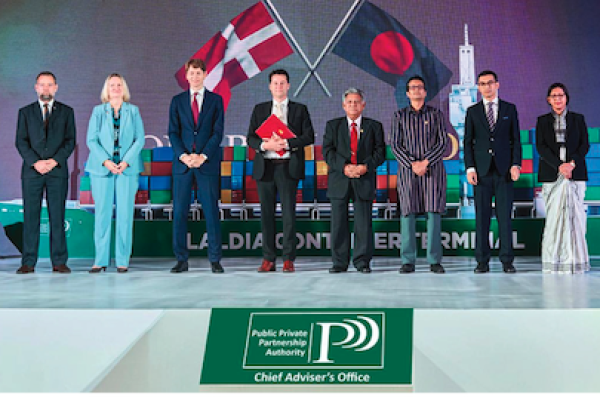
We're also entering the operator-and-systems phase. Last year, we finalised the Laldia Container Terminal with APM Terminals: 100% greenfield FDI, no debt, and a design that will raise Chattogram Port's capacity by 44%. It's proof that strategic infrastructure can be delivered without fiscal drag. Bay Terminal, also scheduled for 2030 under another global operator, will allow direct shipping to Europe. These initiatives are being advanced with the highest urgency to unlock Bangladesh's potential as a regional manufacturing hub.
Vietnam leapt nearly 20 years ago. We're just now making that turn. That means unlearning deep-rooted seaport habits: corruption, discretion, unpredictability. Change is never easy. Yet, despite pockets of resistance,
sustained support and pressure from businesses and investors have kept reforms moving forward. Businesses want to trade with dignity. They want efficiency, predictability, and world-class service that meets international standards.
We ready to learn systems-and to speak the precise language of international logistics: turnaround time, berth productivity, cargo volume per trip, mainline loops, vessel fuel efficiency and information technology.
Our own experience proves it. The New Mooring Container Terminal ran nearly two decades with 3-4 day turnaround times-without serious efforts to compete with faster regional ports such as Colombo. Recent operational reforms reduced turnaround time by 13 percent and increased throughput by 40 percent. These gains were achieved through better coordination and stronger process discipline.
It shows what incremental improvement can deliver. With stronger collaboration with global partners, Bangladesh can now move from incremental gains to full system transformation-modernising port management end to end.